Store Downloads
Products Work in Progress
Support Home


700 Superstar


Screenshots

The Aerostar 700 Superstar

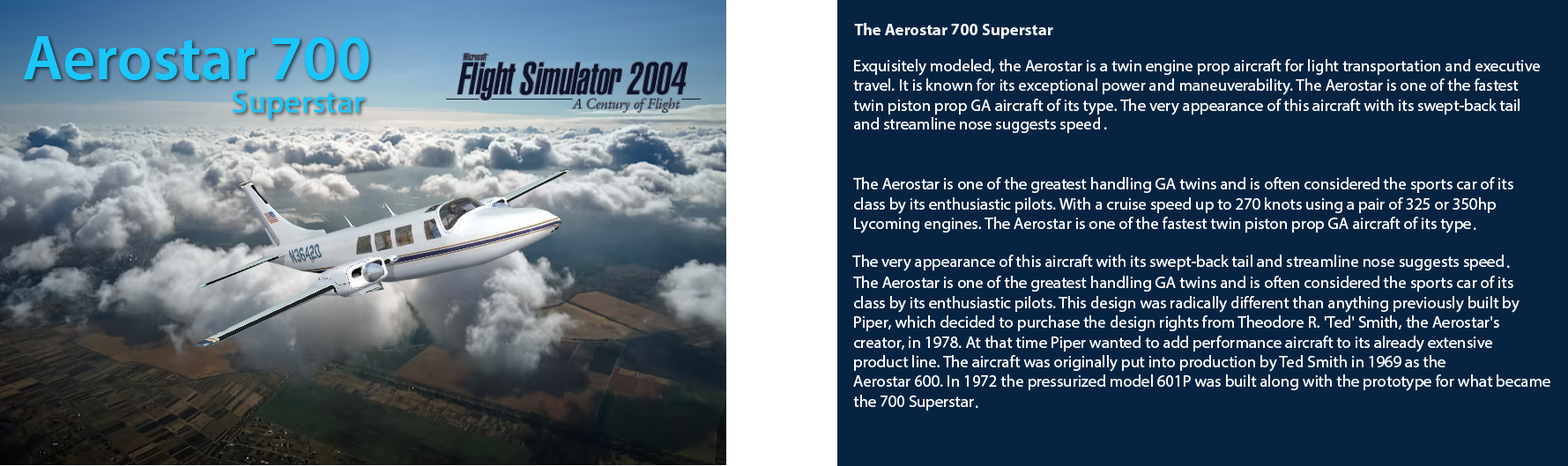
The Aerostar is one of the fastest twin piston prop GA aircraft of its type. The very appearance of this aircraft with its swept-back tail and streamline nose suggests speed. The Aerostar is one of the greatest handling GA twins and is often considered the sports car of its class by its enthusiastic pilots.

This design was radically different than anything previously built by Piper, which decided to purchase the design rights from Theodore R. 'Ted' Smith, the Aerostar's creator, in 1978. At that time Piper wanted to add performance aircraft to its already extensive product line. The aircraft was originally put into production by Ted Smith in 1969 as the Aerostar 600. In 1972 the pressurized model 601P was built along with the prototype for what became the 700 Superstar.


The contemporary version of the Superstar is what FSD chose to model. The Superstar manages to push the cruise speed up to 270 knots using a pair of 325 or 350hp Lycoming engines, making it one of the fastest twin piston prop GA aircraft in the air. 


Aerostar owners world wide are among the most enthusiastic aircraft owners out there, forming owners associations and "fan magazines".  The Aerostar is considered an "aviation sports car" for its nimble handling and performance.


Several very interesting videos are available here:


Features

  • Custom models built individually for Flight Simulator 2004 and Flight Simulator 2002.

  • Takes advantage of all animation and texturing effects available to each version of the simulator.

  • Ultra-realistic flight modeling, with user selectable realism.

  • Full 2D panel/virtual cockpit systems and switch integration.

  • Realistic panel lighting features.

  • Full system modeling.

  • Cabin pressurization.

  • Load Manager for weight and balance settings, as well as keeping track of aircraft data and costs.

  • 9 additional paint schemes available

  • Complete documentation and checklists.


Immersion Factor


The Aerostar represents a commitment to our level of detail in both aircraft and flight modeling.


The advanced flight model of the Aerostar features true asymmetric torque not found in standard Flight Simulator flight dynamics. All aerodynamic characteristics are modeled precisely according to its real world counterpart.


Our systems modeling includes everything you would find in an actual Aerostar, right down to the electrical system.


Aerostar Videos

Here is a video on the FlightSim Developers Aerostar. The video is in WMV format.


High Resolution Low Bandwidth
Virtual Cockpit Virtual Cockpit
Daydream Daydream
Flying Flying


Specifications


Aircraft Dimensions  
Wing span 36' 8"
Length 34" 10"
Height 12' 1"
Weight and Balance  
Empty weight 4,656 lb.
Maximum Takeoff Weight (MTOW) 6,315 lb.
Engines  
          Left: Lycoming LTIO-540-U2A
          Right: Lycoming TIO-540-U2A
Horsepower 350 @2,500 RPM ea.
Propeller  
Manufacturer Hartzell Propeller, Inc.
Hub Model Left HC-C3YR-2LUF/FJC7451(B)
Hub Model Right HC-CY3R-2UF/FC7451(B)
Number of blades 3
Altitude Limits  
Maximum Operating Altitude 25,000 ft.
Service Ceiling 29,000 ft.
Airspeed Limitations  
VA-Maneuvering Speed 160 KIAS
VNO - Max Structural Cruising Speed 215 KIAS
VFO-Maximum Flaps Speed 188 KIAS
VMCA-Minimum Control Speed 85 KIAS
VFE-Flaps Extend Speed  

Mid:       

188 KIAS

Full:       

148 KIAS
VLE-Maximum Landing Gear Operating Speed 188 KIAS
 
Recommended System Specifications
While cutting edge add-on aircraft such as this will "run" on a system with the minimum specifications outlined by Microsoft for Flight Simulator, the following are minimum guidelines to achieve acceptable performance:
  • Microsoft Flight Simulator 2002 or Flight Simulator 2004  required for use of this software
  • Pentium IV or AMD microprocessor or higher with 2 GHz MHz + speed and 1 MB RAM minimum
  • Windows XP or Windows Vista
  • Nvidia or ATI Radeon based 3D accelerator video card with full antialiasing and T&L lighting capability and a minimum of 256 MB onboard RAM
  • SoundBlaster Live or equivalent 128-bit DirectX sound device
  • Up-to-date DirectX video and sound drivers

Obviously, higher end systems with multi-core processors and 3.0 GHz+ speed  CPU, 2+ GB system RAM and 512+  MB or preferably video RAM will perform much better.


Hit Counter

Recent views