|
 |

|
Version 2 |
|
Piper Navajo
Version 2
Download file, via our secure order site.
File size is 36 MB.
$26.95
$18.00
|
Piper Navajo
CD-ROM, shipped via airmail. Order via our
secure order site.
$32.95
$29.95
|
 |
 |
|
|
Repaint
Hangar
--
Find additional paint schemes available
for the Navajo
|
|
 |
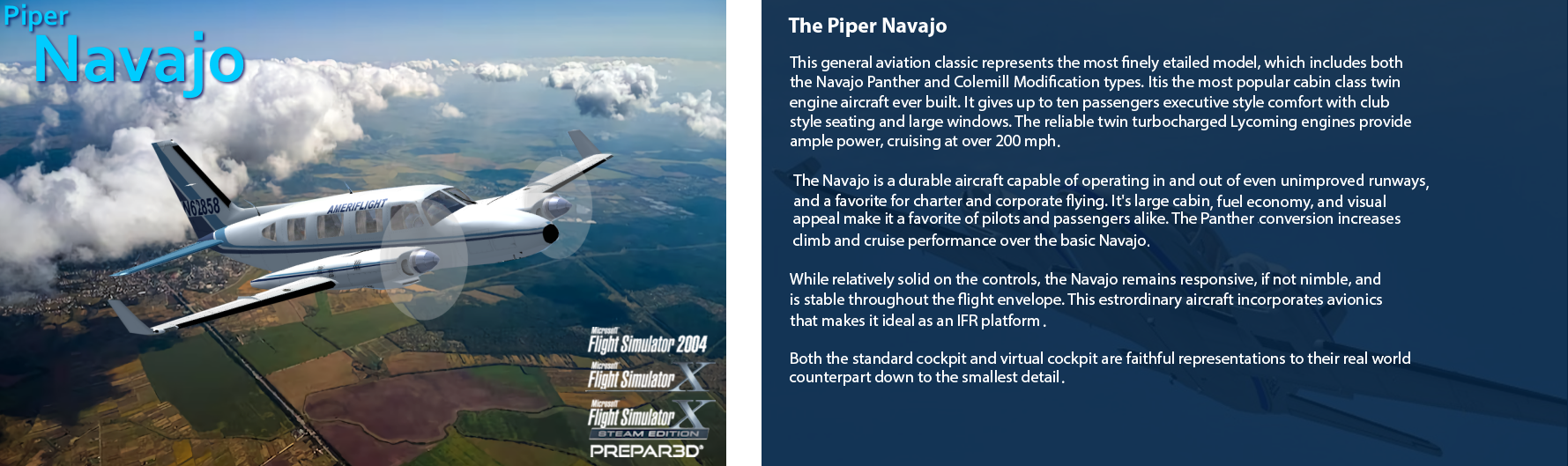
The Piper Navajo |
 |
|
One of the most enduring and robust general
aviation twins ever made is the Piper Navajo. The offers a spacious and roomy
cabin with generous seating for six, a roomy flight deck, and a generous
baggage allowance. The air-stair door set the Navajo apart from contemporary,
more traditional low-wing twin designs of that day.
The Navajo could best be described as a robust workhorse. It is a
satisfying aircraft to fly if flown well, and this durable design serves
operators well. From a pilot's perspective it is a pleasant albeit noisy
aircraft to fly. Flight deck noise levels are quite intrusive at
even moderate power settings and few choose to operate the Navajo without
the use of headsets.
Power plant options available from engine manufacturers are many, as are
propeller options. One such variant is the Panther modification of the Navajo
CR
Colemill version, which
one of the two models
we offer here. This visually striking
modification of the venerable Navajo CR features some immediately obvious
aerodynamic enhancements in the form of prominent winglets. Power plant
modifications include contra-rotating four bladed 'Q-Tip' propellers and higher
performance 350Hp engines with dual magnetos for improved reliability. The
engine and propeller modifications, combined with aerodynamic enhancements,
result in an appreciably quieter cabin and usefully improved performance in
terms of acceleration, increased climb and cruise performance.
 |
Although it has been out
of production for almost twenty years, the Navajo
remains one of the most sought after twin engine
general aviation designs of all time. It has been the
focus of much attention and design enhancements by third
party remanufactures.
Aerodynamic improvements and
improved sound insulation, and cabin sealing being two
areas of interest. The basic airframe offered
considerable scope for comfort enhancements especially
as the airframe aged.
|
|
Several very interesting videos
on several of the Navajo variants
are available here:
|
 |
|
|
 |
Features |
 |
|
|
|
Luxury
and Performance
|
 |
While
relatively solid on the controls, the Navajo remains
responsive if not nimble and is stable throughout
the flight envelope. The Navajo is a good IFR platform. |
|
In the spacious rear cabin (in low density
seating) the noise levels are appreciably lower and not
unpleasant.
Both
the standard cockpit and virtual cockpit are faithful
representations to their real world counterpart down to the smallest
detail. |
 |
Specifications
| Aircraft Dimensions |
|
| Wing span |
40' 8" |
| Length |
34" 7" |
| Height |
11' 3" |
|
Weight and Balance |
|
| Empty weight |
4,250 lb. |
| Maximum Takeoff Weight (MTOW) |
8,130 lb. |
|
Engines |
|
| Two Lycoming engines |
| Left
|
TIO-540-J2BD |
|
Right |
LTIO-540-J2BD |
| Horsepower |
350 @ 2,575 RPM ea. |
|
Propeller |
|
| Manufacturer |
Hartzell |
| Hub Model Left |
HC-E3YR-2A |
| Hub Model Right |
HC-EY3YR-2AL |
| Number of blades |
3 |
|
Altitude Limits |
|
| Maximum Operating Altitude |
27,000 ft. |
| Service Ceiling |
28,300 ft. |
|
Airspeed Limitations |
|
| VA-Maneuvering
Speed |
162 KIAS |
| VMo-Maximum
operating Speed |
187 KIAS |
| VFE-Flaps Extend
Speed |
|
|
Mid:
|
152 KIAS |
|
Full:
|
130 KIAS |
| VLE-Maximum Landing Gear
Operating Speed |
130 KIAS |
|
|
|
 |
Recommended System
Specifications |
 |
While cutting edge add-on aircraft such as
this will "run" on a system with the minimum
specifications outlined by Microsoft for Flight Simulator, the following are minimum guidelines to achieve acceptable
performance:
- Microsoft Flight Simulator X or Flight Simulator
2004 required
for use of this software
- Pentium or AMD microprocessor or
higher with 2 GHz MHz + speed and 2 MB RAM minimum
- Windows XP, Windows Vista or Windows 7 (32 bit or
64 bit)
- Nvidia or ATI Radeon based 3D accelerator video
card with full antialiasing and T&L lighting capability and a
minimum of 256 MB onboard RAM
- SoundBlaster Live or equivalent
128-bit DirectX sound device
- Up-to-date DirectX video and sound drivers
Obviously, higher end systems with multi-core
processors and 3.0 GHz+ speed
CPU, 2+ GB system RAM and 512+ MB or preferably video RAM will perform
much better. |
|
|
|
|
 |
|
Recent views |
|
| |
|
|
|
|
|
|
| |
|