
Home Support Company Contact Us
Northrop T-38 Talon |
regPrice |
|
Add to cart |
Features |
Reccommended System Specs |
||
|
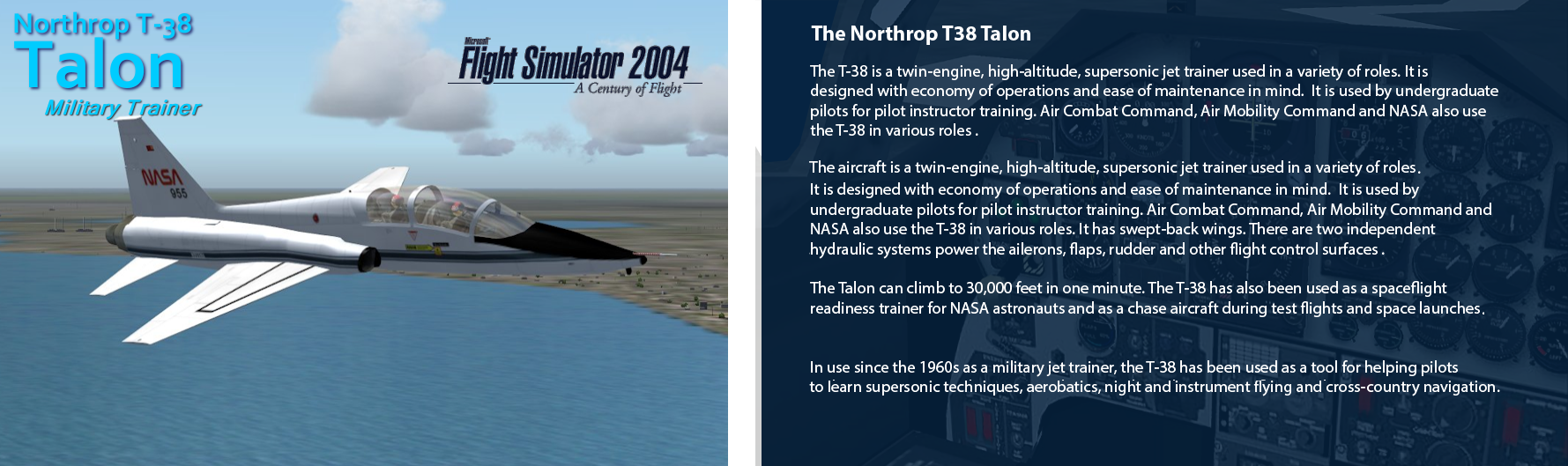
Detailed model built for Flight Simulator 2004 Takes advantage of all animation and texturing effects available to each version of the simulator. Ultra-realistic flight modeling, with user selectable realism. Full 2D panel/virtual cockpit systems and switch integration. Realistic panel lighting features. Full system modeling. Cabin pressurization. Paint Scheme Manager. 9 additional paint schemes available |
Compatible Simulators: Flight Simulator 2004 Dual Core microprocessor or higher with 2 GHz MHz + speed. A quad core processor are recommended. 4 MB RAM minimum. 8 MB RAM or higher iss recommmended. Windows versions 11, 10, 8, 7 Nvidia or ATI Radeon based 3D accelerator video card with full antialiasing and T&L lighting capability with a minimum of 4 GB onboard RAM minimum. 8 MB is recommended. SoundBlaster Live or equivalent 128-bit DirectX sound device. Up-to-date DirectX video and sound drivers. Obviously, higher end systems with quad-core processors and 3.0 GHz+ speed CPU, 16 GB system RAM or higher and 10 GB+ video RAM will perform much better. |
||
| Screenshots | Manual |
